A Pretty Good Day
I've had some people ask me what a typical day is like at sea, how does the catapult feel, etc. This should answer some of those questions. Hope it's not too dull.
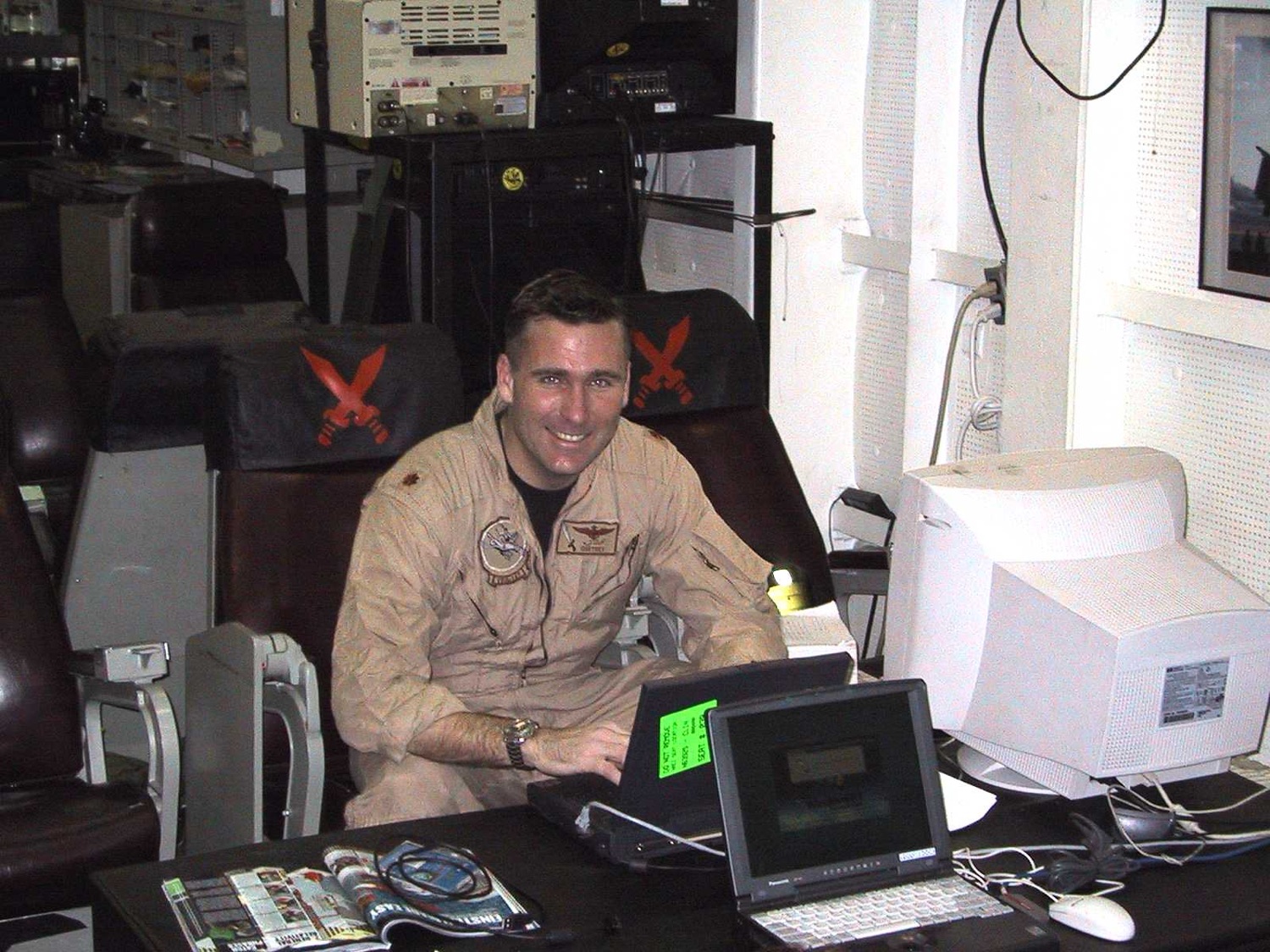
When does a day begin? Is it when you get out of bed or is it when all possibility of additional REM sleep is exhausted? If it's the latter, I'd guess my day started around 0430 when an elevator fell 38 floors and slammed to a stop in my room. I reacted like anyone would who had something like that happen, or at least someone who sleeps at the bottom of a defective elevator shaft. I rolled over and cursed the bastard(s) that had made the noise. It wasn't an elevator, of course, but one of the catapults amidships (or the ‘waist cats’, as they're called). And from the sounds of it, things were not running smoothly. As the catapult was pulled back again, as it was being cocked actually, some mechanism was clicking badly. When I say ‘clicking’ it's important to recognize the cat was physically 70 feet away from me and I was hearing all of this through a dozen walls of half-inch steel. So the ‘clicking’ was a major malfunction, I suspected. (That's the way it is on the boat - you don't notice huge booming noises you only notice the huge booming noises which aren't normal. The normal ones don't even cause you to blink an eye, unless you're trying to sleep.) I was right. Apparently the maintenance manual said, "For odd clicking noises continue to fire catapult at odd intervals until flight ops commence." And that's what theydid. And that's when my day started.
Around five thirty I got up and ducked under the AC vent eighteen inches above my pillow. (All ceilings on ships look like a hardware store exploded and all the pieces stuck to the ceiling. At least ships of war look like this.) Grabbed the light and swung myself out and down to the floor (bunk bed, don't know why I thought this was so cool when I was a kid). Landed right on the bean bag and almost spilled onto the floor. "Man it's dark!"
Did the three S's and headed for the ready room. (For you old timers in the audience we got ‘Hollywood Showers’, Nukes Rule!) I live on the O3 level.
This means I live three floors above the Hangar Bay and one floor below the Flight Deck. The ready room is on this same floor which means I don't have any stairs to navigate during morning rush hour. I was pretty thankful for this given my dismount from bed.
The O3 has two long hallways running the length of the ship and every six paces or so are five-foot tall steel ovals that only one person at a time can fit through. (These ovals are called kneeknockers because of a steel lip about eight inches up from the floor. You gotta be walking kinda funny to knock a knee on these things but I'm not one to argue with tradition.) With people walking both ways there is a constant scan required to keep things flowing. There are certain rules covering who goes first through the hole. People running get priority. First because if they're running they must have something important to do when they get where they’re going and second you want to take a step back and get a good view because if they trip it's gonna be bloody. (The only soft landing possible on an aircraft carrier is when you fall out of the hangar bay.) Next comes a balance between rank and range to the gap. Women get no priority whatsoever. I noticed quickly that if you let women go through first it messes up the rhythm and people look at you funny, like it's a pick up line or something.
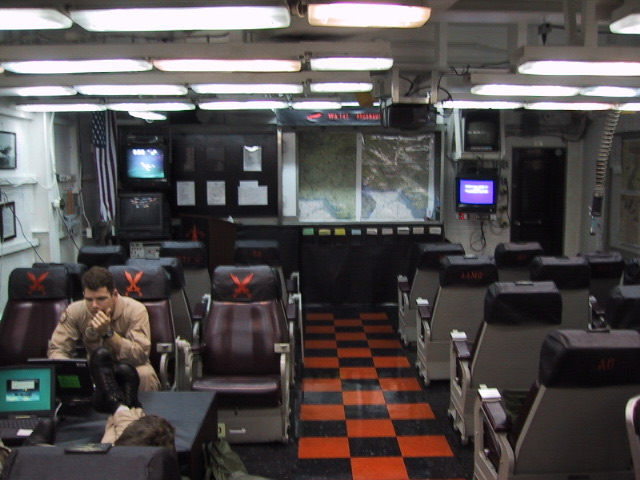
Morning Brief for a BFM Flight (Basic Fighter Maneuvers otherwise known as Dogfighting). This is what makes it worthwhile. Well, not the brief but the flight. If anyone has considered men to be noncommunicative they should see this little evolution. I was flying with "Dusty" Rhodes who was working towards his section lead (a qualification to lead two jets in combat). This was a syllabus hop so Dusty had studied hard and put up a briefing board up that was just an object de arte. (Square block writing, flight arcs and weapons envelopes; appropriate use of color, highlighting things that needed it but not distracting.) Then came the brief. The funny thing about BFM briefs is they are typically longer then the flights/fights themselves. (I just now realized this and I'm conflicted about it.) He was talking and I was listening and taking notes. It was a good brief but I still came up with a page of misspeaks I could debrief with him (I'm an anal son of a bitch since leaving TOPGUN). This went on for an hour and fifteen minutes. Think about that. When was the last time you sat down one on one with someone and listened to them talk for over an hour? Men can't communicate? Ha! This is communication!
We broke and I grabbed my standard morning coke. Grinds my stomach up sometimes but I need the kick, since I don't eat anything in the morning.
Next I ran out and talk to the guys that fix the jets. It was early so night duty section was still awake. Bleary-eyed old senior chief with a bathtub full of coffee at his elbow handed me the book. He then reminded me not to break the jet, really giving me some shit. This was the standard between us, if he didn't give me shit I'd feel like my mojo was messed up. (Flying behind the boat is a superstitious evolution.) Threw on my flight gear and headed to the roof. (The roof of the O3 level is the flight deck.)
Morning man ups. God help me, I do love these. It is quiet and cool, two unusual adjectives to describe the flight deck. Typically it is pretty hectic up here. Twenty planes moving around blowing jet exhaust, helicopter blades swinging, props spinning and moving, catapults firing, huge walls coming up out of the ground (Jet Blast Deflectors used to keep jets about to be launched from blowing everything behind them off the ship), horns blasting and people yelling, alot. Kinda tense - probably the most dangerous job site I've ever seen. But not in the morning, not for the first launch.
I walked to my jet (at least this morning it was mine) and talked with the Plane Captain (PC) for a minute. The PCs are new to the squadron, typically less than a year and are responsible for the daily care and feeding of the jets. Good guys, but real young so you gotta watch out for them sometimes. I was prone to doing stupid stuff without warning when I was younger (still am, depends on the current martini count) but I wasn't on the flightdeck when I was young. So the consequences were not nearly so severe. (The Eisenhower lost a PC ten days ago when he walked into an E-2's turning prop.)
I was doing the preflight and getting into my habit patterns, all on automatic. The Flight Deck Chief came up and had me sign something. I walked over the cat (catapult) track, 5 feet wide and two hundred feet long, all steel and grease, and almost fell. This is normal; the cat track is always slick. The PCs like to run across the flight deck and skid down them when they think no one is watching. Kind of like skim boarding on the beach except instead of sand it's steel and nonskid when they fall, and they do fall.
Hauled myself up the ladder and into the cockpit. Three TV screens (with twenty buttons each) and about 30 switches and knobs. This is the office and I'm pretty much at home here. The start went quickly, I'm flying my ass off out here and all the administrative stuff is becoming more and more rote with each day. It now takes me about five minutes to start everything and ten before the INS is aligned. (Inertial Navigation System, the heart of the way the pilot flies the Hornet, so it's kinda important. Landing without it is a lot of work. I can hear the old guys now, "Young punk, why when I was flying..." Yeah, yeah - I know.)
The plane guard helo launched and went right over me at about 15 feet. The Boss (senior guy in the tower who runs the flight deck, the landing pattern and who is responsible for yelling at people) yelled at him, which I expected. The Helo guy apologized, which I didn't. Never apologize on the radio, makes you sound like a weenie. I was parked all the way up forward on cat 2 so I watched the S-3 and E-2 take off right in front of me on cat 1. It's at times like these that I am reminded just how violent the launch is. The E-2 was 200' away from me at a dead stop and max power; the wings, tail and dome all shaking and twisting in different directions. Black exhaust was going straight up after "deflecting" off the JBD. The cat fired and two seconds later the airplane (and the five people in it) were right next to me at 120 knots leaping from the flight deck. I could see the two pilots, one had his head pinned back, the other was fighting it - head strained forward, right hand on the dashboard pulling. Good knows what the people in the back of that thing (tiny windows) were thinking/doing.
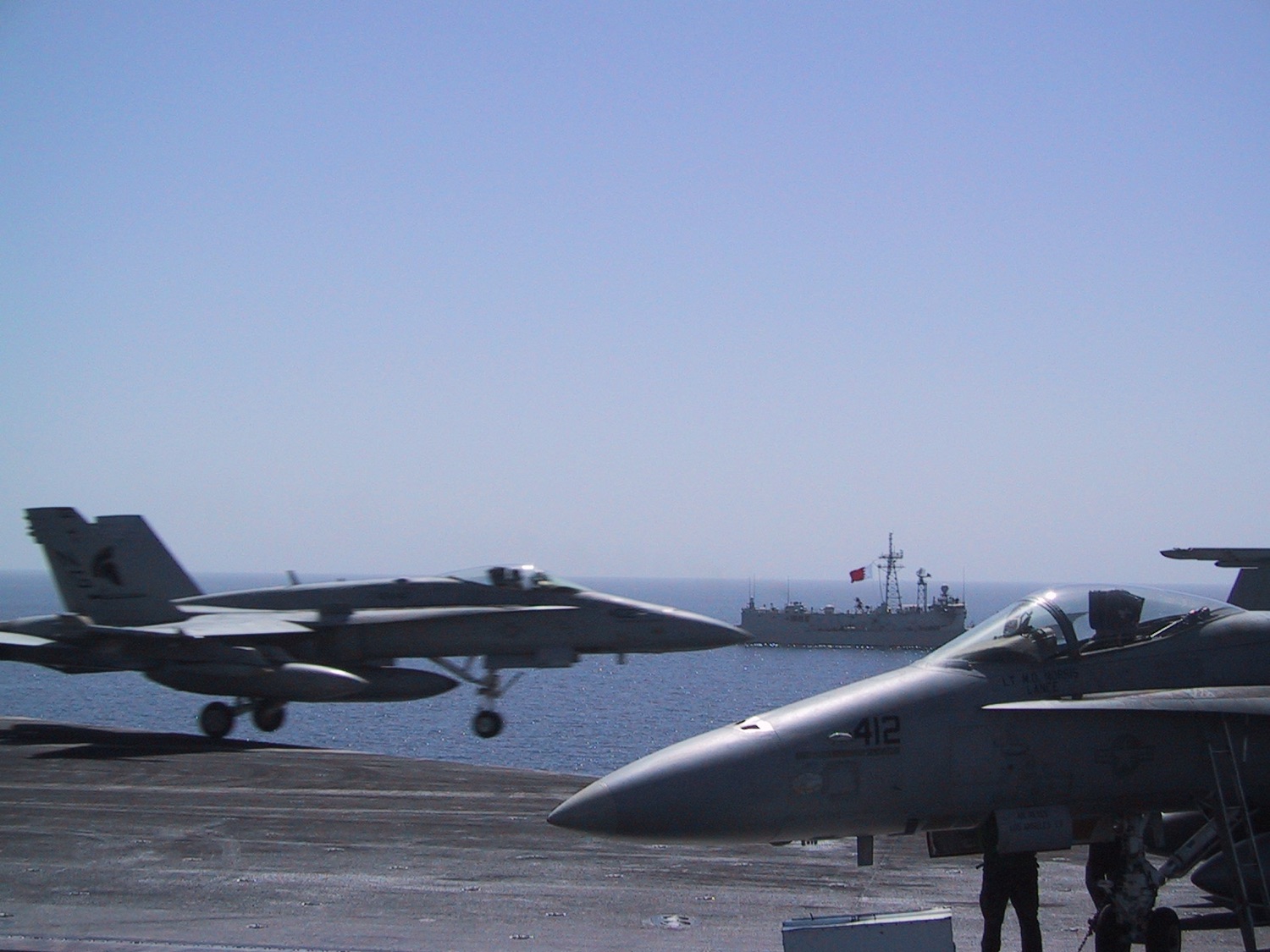
They pulled all the chains off my jet and then taxied me out of the bow. The ‘yellow shirts’ tightly control every foot a jet moves because the flightdeck is so jammed with airplanes and people. They do this by waving their arms over their heads in different ways, giving different signals. The yellow shirts are pretty salty enlisted guys with some savvy. Each one has his own style and mannerisms. Having flown and therefore taxied a fair amount around here I can recognize each one on sight even though I've never seen these guys without all the flightdeck gear on. If I saw them in a bar I wouldn't know them until they started waving their hands over their heads. During most of the taxi my nosewheel was on the cat track so when they steered me left and right to avoid other jets the experience was like using a rudder, not a steering wheel. A lot of the flight deck was getting slick. Four months of leaking jets and continuous flight ops has made the taxiing experience a lot like driving on an icy road.
I ended up over at cat 3. This was the cat that made the loud clicking noises just three hours before. "Sure hope they fixed this thing." I reached down to make sure the ejection seat handle was where it should be and touched the emergency jettison button. If they hadn't fixed it (and at the time I was seriously hoping they had) I would have needed both of these, but not necessarily in that order.
Planes were shooting off three different cats now, the pace of the launch had really picked up. Weather was beautiful so no words were spoken, except the Boss (the man in the tower looking down on the flight deck – in charge of everything). One guy didn't turn quick enough on takeoff; another guy didn't climb high enough for the departure. Yak, Yak, Yak. The closer I get to the cat the more my adrenaline picked up. As my adrenaline picked up, my threshold for annoyance lowered. The Boss was really pushing some of my buttons. Not that it mattered. I wasn't going to say anything and I was going to turn and climb just fine. But still, pilots hate unnecessary comm (communication) and he was spewing it over the airwaves and into my helmet and therefore into my head. All those moments ripe for smart-ass comments floating across the ether made it tough to compartmentalize.
Cat Stroke. They taxied me up to the cat and I lowered my launch bar. (A big piece of metal that connects the airplane to the catapult.) "Wings spread and locked, flaps half, trim set, no cautions, dispenser off, radalt set, no cautions, engines are good." Yellow shirt gave me the signal and I ran 'em up. Throttles went to military power (max without afterburner) and the jet screamed but didn't move. The cat locked in place with a thump and the jet squatted down. "7s, 8s and 9s, engines good, no cautions, flight controls good. Wait…what was that extra thump?" I got this about once every other day, an extra thump when I'm on the cat. I've seen too many film clips of bad things happening on the catapult to not have these thoughts running about in my head at times like these. Launch bar could pop out, leaving me stranded. The cat could be cold, on and on and on. You'd figure I'd get used to this, but I don't. Down side of an active imagination I guess. "Well the cat's not my job. The jet's my job and she wants to go." Looked up, threw a quick salute to the cat Officer and waited.
This part always sucks, frankly. The catapult Officer looked forward and then aft to see if there was any reason to stop the launch before he touched the deck. Now, if the cat fired right then and there it'd be fine. But touching the deck is just the signal for another guy to look forward and aft for any reasons to stop the launch before he punches what, I can only assume, must be a very big button. Then the cat fires. Problem is I can't always see the second guy (depends on what cat I'm on). So sitting and waiting for it is kind of like being at the doctor's office with your sleeve rolled up, waiting for the poke. Typically I hold my breath for all of this. Right about the time I figure the launch has been stopped for some reason (because it's obviously taking too long) and exhale, it happens.
When the cat fires the seat drops down about three inches and starts blasting forward. This sets up a quick iteration of about three vigorous bounces which are almost unnoticeable because of the acceleration. My feet come up off the floor and my head slams back. It doesn't knock the breath out of me but I'm not sucking any air in at this point, that's for sure. I try to look at the airspeed to make sure I'll have enough at the end.
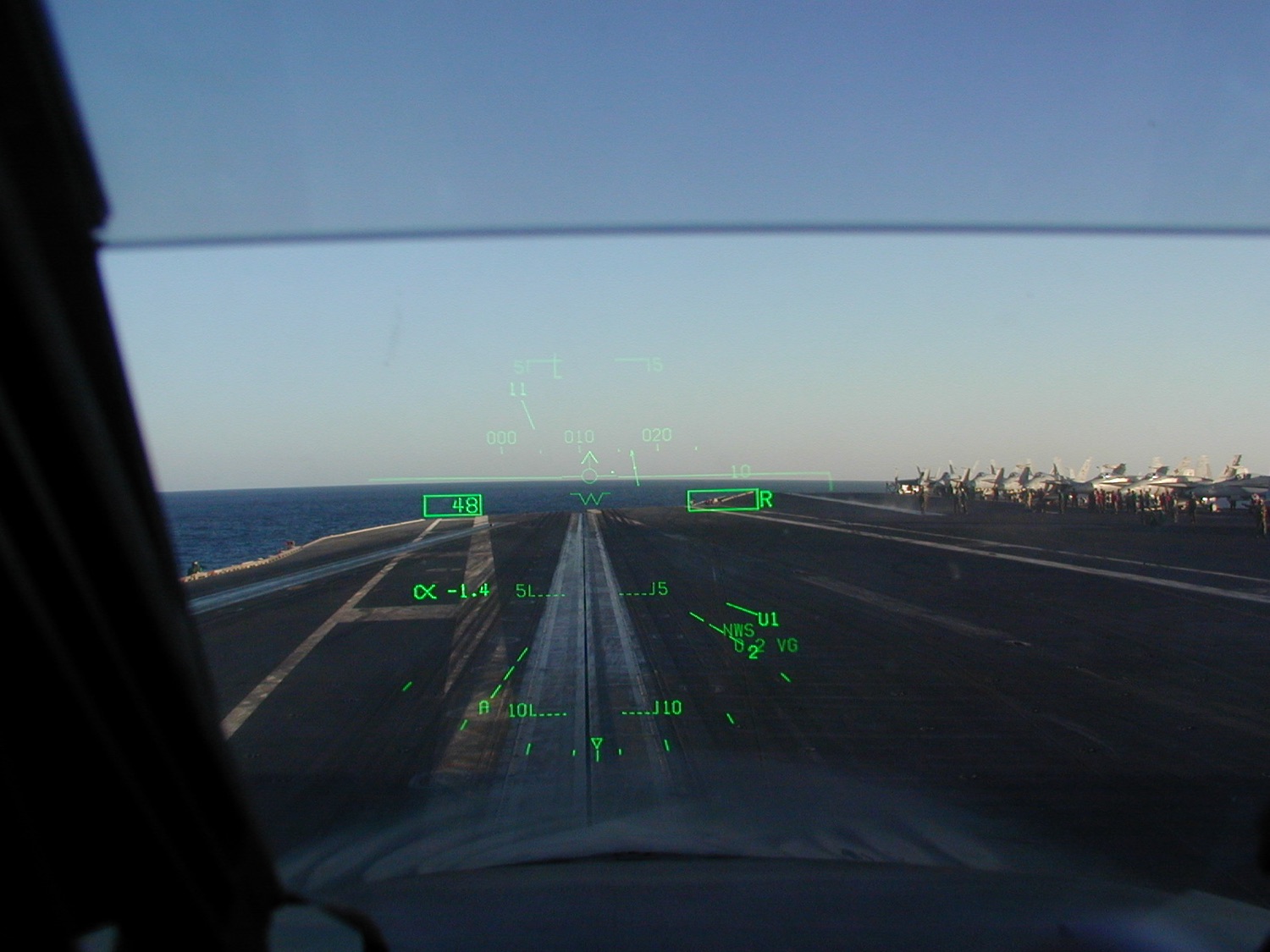
That's what I'm supposed to do. To be honest though, all I'm doing is thinking either, "WEEEEE," during the day or, "SSHHHIIIITTTTT," at night. I don't notice much except the deck edge rushing up at me. Right before the ship disappears under the nose I'm slammed forward at the end of the stroke. It feels like I hit something. Actually I'm still accelerating but the rate goes down to nothing compared to the cat shot. I look for a second to make sure I'm still flying and recage my brain. Typically I'm still flying.
Gear handle came up and I put in a shallow turn to avoid the guy that had just come off the bow cat. Raced out to 7 miles at 500' or so and started climbing overhead the ship. I found my wingman at 18,000' and joined up. We headed out to the north of mother (as the ship is called) and set up for the fights. It was a good deal for me as Dusty was practicing defensive BFM. Which, by process of elimination, made me offensive. Which is a good thing. Essentially it's an unfair fight. I start out back near his extended four o'clock shooting at him. I like these kind of unfair fights, it's when I'm on the receiving end of this punishment that it's an "injustice."
He broke back hard at me, I countered. He ran out of options so he changed the flight flow, down. I countered. He reversed back into me again, I countered. We were pulling 6 or 7 g's for a lot of this and he had to look over his shoulder during all of it. Felt bad for him, just a tiny little bit. He was doing well but the setup made it hard to do much beyond break even. We ended up 5000' above the Gulf weaving back and forth, huffing and puffing and starting to sweat. After the fight I raised my seat up an extra inch and got the oxygen mask up off my chin. (High G is like instant aging, everything sags.) As we climbed I tried to jot down some notes about what had just happened. The notes pretty much looked like I tried real hard to draw a fur ball.
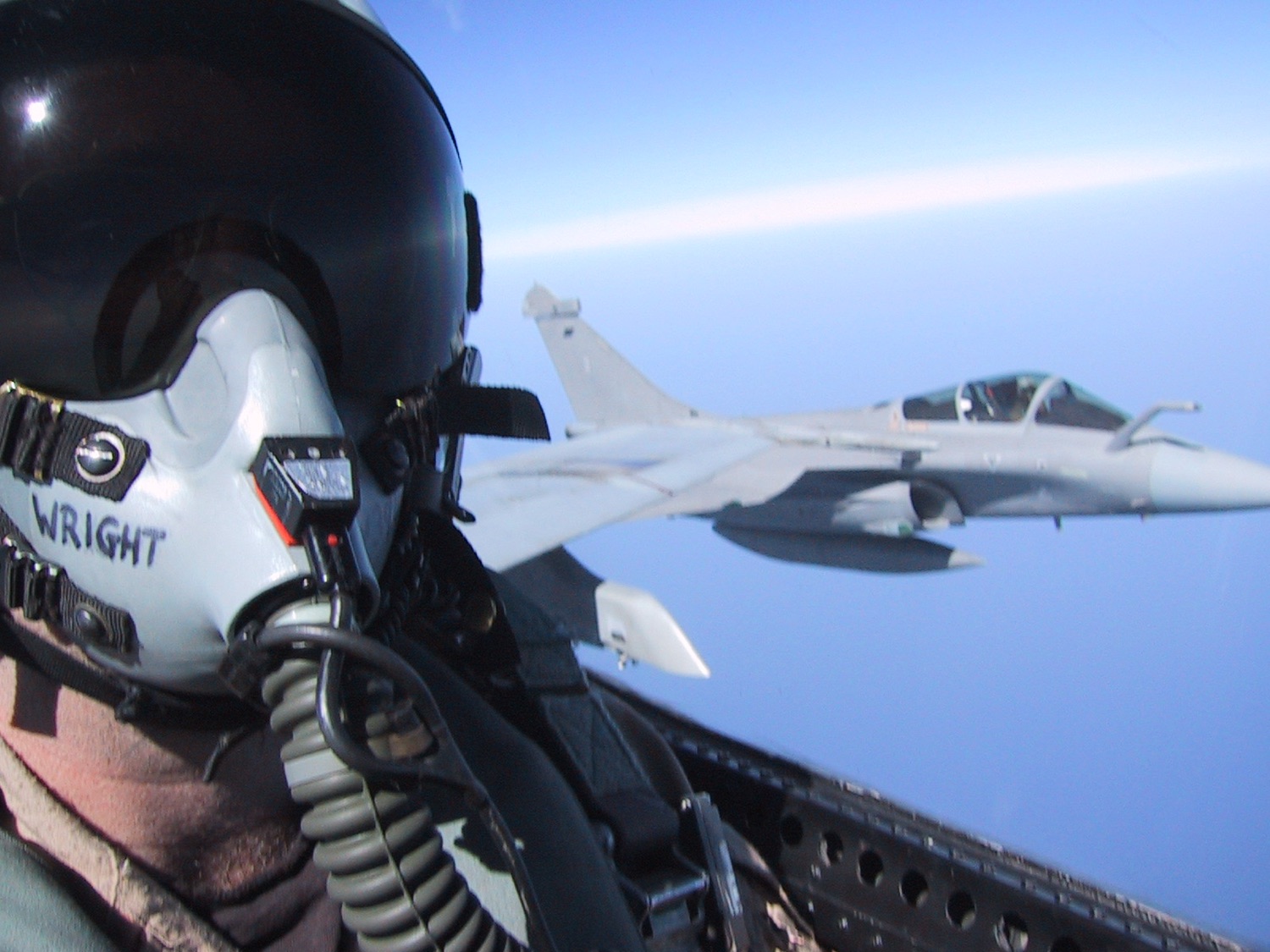
Two more sets and it was time for us to return to the boat. Everyone from the launch was heading back to the "stack." The stack is a holding pattern overhead the ship where everyone waits for the launch to finish. Fighters down low (typically have less fuel and need to get aboard first), with the bigger airplanes up high. The goal is to get the first plane down within two minutes of the last plane taking off and recovery a jet every forty-five seconds after that. That and not say anything on the radio. So we came in at three thousand feet and started circling. We saw the Marines come in and got across the circle from them. Tomcats and two more Hornets below us all were waiting for the deck to clear.
As is typical when I'm low on gas, and I was LOW on gas, something "interesting" happened. When I'm in tight spots I really hate it when interesting things happen. I'd prefer it if things stayed dull but that wasn't to be the case. I still don't know what it was.
I just know the Boss came up on the radio and half shouted, "Ninety-Nine, delta easy!" (Poor technique, never panic the potential victims.) Translation: "Everybody stop wasting gas, it's gonna be awhile." Since I wasn't wasting any gas at the time that left me absolutely nothing to do. So that left me time to think. What I was thinking was, "Do I own up to being low on gas now and cause a whole big mess or do I just hope things clear before it gets real ugly?" I went with the later and it worked out. Life's good sometimes.
When our turn to recover came we descended down to 800' and came in for the break. A level turn to set up for the landing. I gotta be honest here, the day landings are pretty fun and a little tricky. The rush I get is like when you go blowing through a yellow light with a cop watching. Feels like it should be illegal but it's not. The landing is about half as violent as the cat and I'm in control, double the fun. (Though I've had landings that were twice as violent and I felt fully out of control. The kind of landings that has people standing around the flight deck shaking their heads, because everyone's a critic in this business.) I caught the fourth wire of four which resulted in me running out almost all the way to the deck edge. This used to bother me more. Frankly the first couple of times it scared the crap out of me. The only thing I knew the first time I hit a four wire was I was not fast enough to go around again and it sure didn't look like I was going to stop in time. But typically these things work okay and I did stop.
Taxied out and parked, all the way forward again. Getting down out of the jet the Chief thanked me for not breaking the jet. Apparently, things were going poorly and this was only the first recovery. Two major hydraulic leaks on the previous launch. Two down jets. The maintenance guys spotted one of the leaks as the jet was going into tension on the catapult. They do good work and this time they probably saved the pilot a lot of heartache, preventing him from having to deal with an airborne emergency. The plane captain came out from under the jet and asked me how the flight went. He could tell it was good because of the ear to ear grin I was wearing. We shot the shit for a little bit and I headed back aft to get to the ready room.
The flight deck was in its normal state now. All noise, heat and motion. The recovery was still going on so every 45 seconds another jet would roll out in full power, the pilots thrown forward in their seats. An E2 landed last and I hurried to get off the flight deck. Those props give me the willies. As I was walking behind the island, I noticed the bomb farm was starting to fill up. All the ordnance for the afternoon strike was coming up from the bowels of the ship. Rows and rows of Laser Guided Bombs IGBs), Air to Air missiles and various other smart weapons. A not so subtle reminder that in seven or eight hours I was going to be paying the United States Government back for the privilege of the mornings flight.
I left the flight deck and started walking back to the ready room. Sweaty guys just back from a flight have priority over all others at the kneeknockers. I shucked all my gear off and hung them up. I was thinking they probably wouldn't dry before I manned up for the strike. Kind of like putting on a wet and cold wetsuit. Yuck. It took about fifteen minutes to fill out the paperwork on the flight. Forms, forms, forms, I do work for the Government after all.
Next came the debrief. Another episode of men communicating. We try to rehash what went well and what went wrong in debriefs. First Dusty drew up what he thought happened, using the furball he'd written in the jet after each fight. After that we'd watch the tapes. We have a little camera on the dashboard of the jet. It looks straight out through the Heads Up Display so we can see at any time how high, fast, hard (G's) we're flying. It also has all the symbology (not a real word but it works best) for the various weapons we shoot at each other, in a simulation mode.
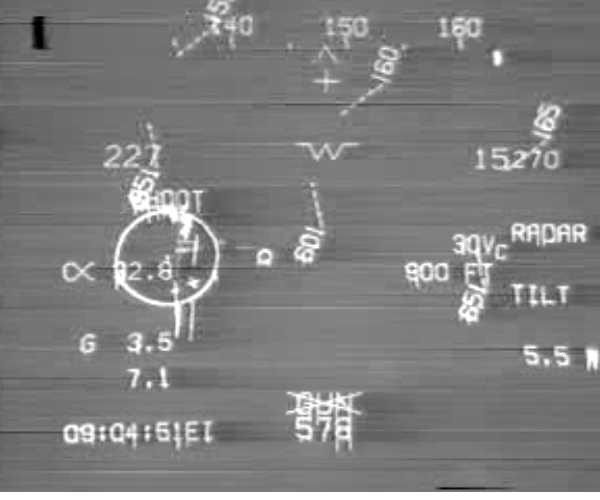
Though, actually Dusty didn't get a chance to shoot this hop. (Like I said before, I love these kinds of unfair fights.) Most fights have one or two points in them were someone makes a mistake and gets punished for it shortly afterwards. On the tapes it's pretty obvious where these points are. They are usually coincident with the guy saying, "Aww Shit." Dusty had four or five Aww Shits and I had a couple myself. We figured what we could have done better and then we broke for lunch.
After lunch I had a couple of hours to kill before the next brief. I went to the intelligence center and checked in with the Strike Lead. It's a good thing I did because there was a change to the plan and I was now leading a division (four jets) of strikers looking at an SA-3 site up near the 32nd parallel. While the good of this was I wasn't going to have to fly form off someone else (at night with no lights, translation: not fun), the bad was I now had to put together a plan and a brief for the flight. At times like these the simplest plan is probably going to be the right answer and I set to work on what I thought would be the simplest plan. The Strike Lead ("Chunks" a Tomcat RIO) was great, "I need you here at this time and you own the Prowler for 15 minutes from this time to that time. Everything else is up to you. I need your route in one hour." I love dealing in absolutes.
What was driving the whole flex was the Iraqis. They've found out (the hard way) that if they leave any Surface to Air missiles or AAA Guns in one place south of the 33rd for much more than a day, we'll erase it from the face of the planet. (At least that's the way it's supposed to work, when and if we actually drop is up to the General in Saudi Arabia. And after looking at guns shooting at us in the same spot for a week I don't know what his criteria is for dropping. Sometimes I think he's using Tarot cards.) So the Iraqis move stuff pretty regular. Someone happened to spot a SA-3 and they sent out some urgent e-mail (it's all e-mail nowadays) telling us to run at it. It's important to stress they just wanted us to run at it, not strike it. We may or may not actually get to drop on it. It was likely that we wouldn't know what we would really do until we were over Kuwait north bound. Either way we were going into SA-3's envelope if only for a little bit of the run. If we got to actually strike then we'd be living in his envelope. That's what the Prowler was for. That jet would jam the SA-3's radars so they couldn't shoot at us, hopefully.
And that's about as complicated as the plan got. Next I had to put together some materials to help with target acquisition. We would be using LGBs on the target so we had to find the pieces of machinery out in the desert before we could release. More than that we had to be damn sure it was the right spot before we could drop. An F-16 driver in Kuwait got sent home two weeks ago because he dropped in the wrong spot. Now one wanted to go home that way so the three guys I'd be leading and myself studied the target area very hard. Of course that wasn't the only target we had to study. We had to look at five or six because the General could call for a strike in any of the target areas. The SA-3 was the percentage bet for us to strike but if the F-16s or the British Tornados missed we'd be rolled over to cover their targets as well. So we're pulled in two different directions at times like these. The responsibility of what we're doing demands we study the targets extremely well. This was especially true since this was a night strike and we weren't going to be able to study a new target airborne in a blacked out cockpit while trying to not hit each other. On the other hand, we never want to miss a chance to execute and anytime we can show up the Air Force we're all over it. This means we end up studying for, I think, too many targets.
The fact that all of this was probably going to be for nothing was also eating at the back of my mind. The likelihood that the proper Tarot card was going to be pulled was small since the Iraqis hadn't shot at us much lately. And what they do drives what we do. They shoot a missile, we'll crush 'em. They fly south of the 33rd, we'll crush 'em. They shoot AAA at us; well that's a crapshoot. This is not a war, it's ‘containment’ and we've told them (with ordnance) that shooting missiles and flying south is unacceptable. We've also told them that shooting guns at us is not good but not as bad as the first two. The politicians don't want Iraq as a reelection topic so if we can minimize the number of page six news stories about US airplanes killing civilians (which is total bullshit but a different story) that is a good thing. So we do. The guns are not a tremendous threat but it goes against my grain to accept that these guys can shoot at me and I can't return the favor most days.
After awhile we all headed down to the Tomcat ready room for the strike brief. Thirty or thirty-five people crammed in watching the power point slides. Chunks was going over the coordination portion; frequencies, who goes where for gas, what altitude for every one to be at etc., etc., etc. Funny part is this brief, which involves far more people than this morning, is much shorter than the BFM brief. A lot of things at this point are standard. Doesn't make them any less interesting to execute but it doesn't need to be rehashed in the brief either. Chunks was taking jets to Tallil to look at some S-60 AAA guns. I was going to Al Najaf, the Tornados to Basra (poor bastards, there's guns all over the place there), and the F-16s had As Sammawah.
We had the only SAM site so everyone was thinking the right card was going to be pulled and my division would execute. I wasn't so sure. It just didn't make any sense to me. This was Chunks' strike, “why did he given me the juicy target?” I suspected the Navy representative in Saudi (sitting next to the General) had emailed chunks and given him some tipper information. You can drive yourself nuts by getting psyched up with every rumor that comes out of the computer. I knew this too well at this point. But I didn't want to let this come across in my portion of the brief. The guys in my division were going to be working hard tonight and a lead that briefs without conviction is bad for morale.
We finished and still had about forty-five minutes before we had to walk so I headed back to Intel to see what had changed. Nothing. That was good so I headed to the wardroom to grab something to eat before the flight. After all the plans and decisions I'd made that afternoon I found myself vaporlocked at the coke machine. For the life of me I couldn't decide between coke and sprit. I needed the caffeine but if I drank too much I'd end up having to take a piss somewhere west of the target. Three and a half hour flights force you to make some tough choices about your diet as the repercussions of a poor decision are traumatic. I went with the coke and hopped for the best.
Next problem - the night man up. Put on the wet flightgear (yuck), 9mm pistol, extra GPS, extra water, extra ammunition (like I'm going to shoot my way out) and headed up to the roof. The flightdeck was still in full swing except now it was dark. Jets were parked so that I had to walk behind them to get up to the bow. Problem was I couldn't tell which one was running and which one wasn't. Everything was loud so I couldn't use the noise to judge. I had to stick my hand out and see if it got blown back by exhaust. The Hornet's weren't turning but the Tomcats were. Shit. The problem with the Tomcats are they are pretty low on the back end, so crouching down to get underneath the jet blast required more effort than I wanted to expend. Walking around the front wasn't going to work because that would put me in the landing area. So I waddled underneath four Tomcat TF30 engines enroute to my Night Strike Fighter. Not exactly looking like the proud giant killer I wanted to be. The E-2 fired up just as I was walking past and I thought to myself, "Fuck, I hate the flight deck at night."
I found my jet and started the preflight. It was a very different jet from this morning. Two LGBs, three air-to-air missiles and a full belt of ammo were all on it / in it now. This was a jet going to work. She looked good, but I always think the Hornet looks good. Smooth curves blended with sharp angles. Form followed function here and the form is beautiful. I hurried the preflight as I had a lot of things to do in the cockpit to get ready for the flight. Plus the sooner I got in the sooner I'd be off the flight deck. Fired everything up and started typing in coordinates, resetting radios, testing sensors and playing the flight out in my head. Again and again.
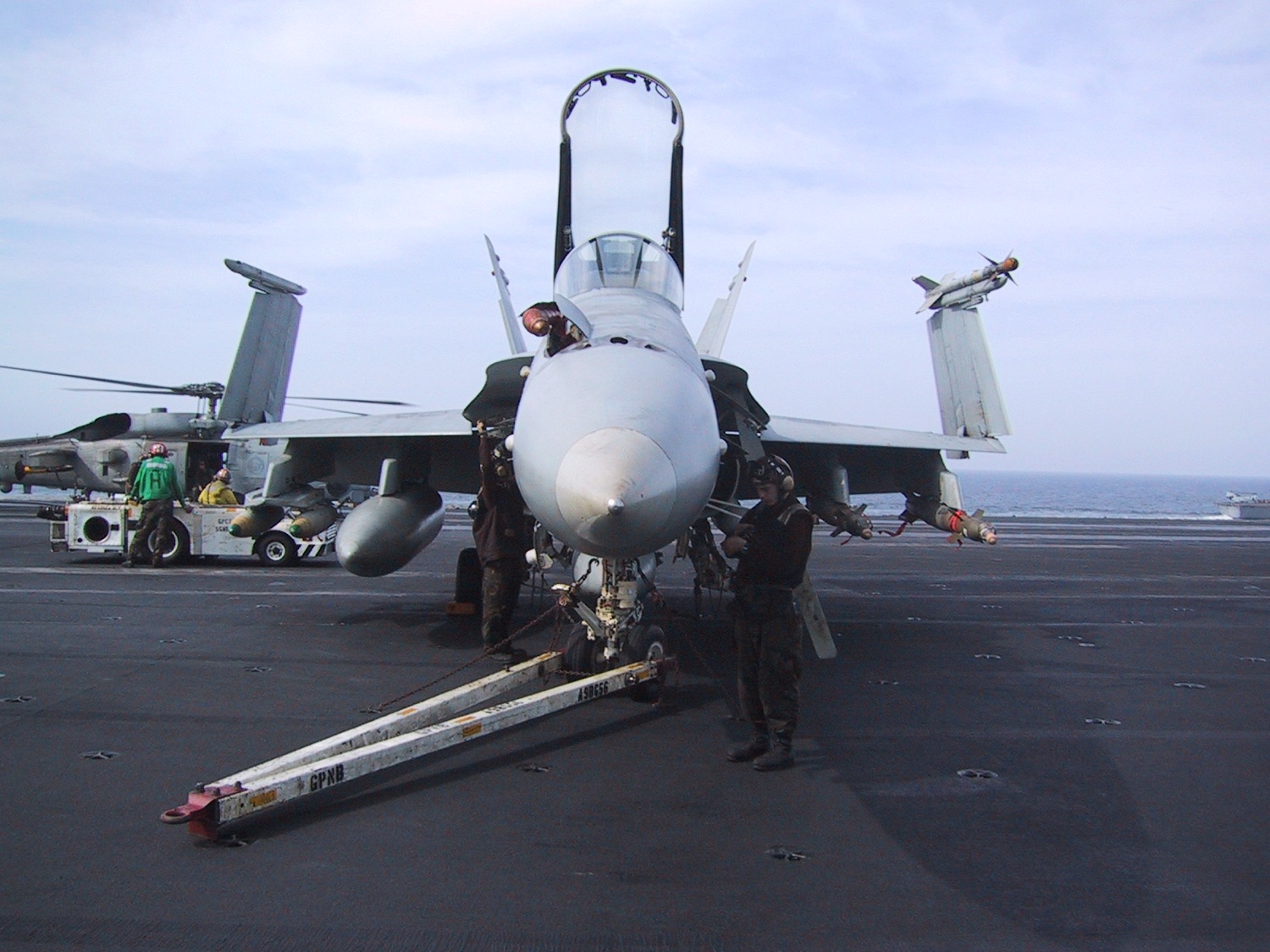
They taxied me out and back to the waist. Same slippery ice feel except I noticed it a lot more because I had less visual cues to what was going on. The lights were down for the launch and the only thing plainly visible were the light wands of the plane directors. Things were behind schedule, I could tell that by the wands. They were clearly impatient with the pace everyone was moving. Tempers were growing short as the long hot day started to wear on everyone. As I got closer to the cat I totally forgot about the mission and went through my prelaunch mantra. The blood was pumping as I remembered how much I hated the night cat shot.
The night cat shot feels exactly the same physically. It is completely different mentally. The half-second when the acceleration stops and my brain is still on the flight deck causes profound disorientation. There's nothing to look at except the HUD. Everything else is completely black. Scary or not, I made sure I sounded cool when I keyed the radio. Goes back to not wanting to sound like a weenie in public. "Jason 400, Airborne."
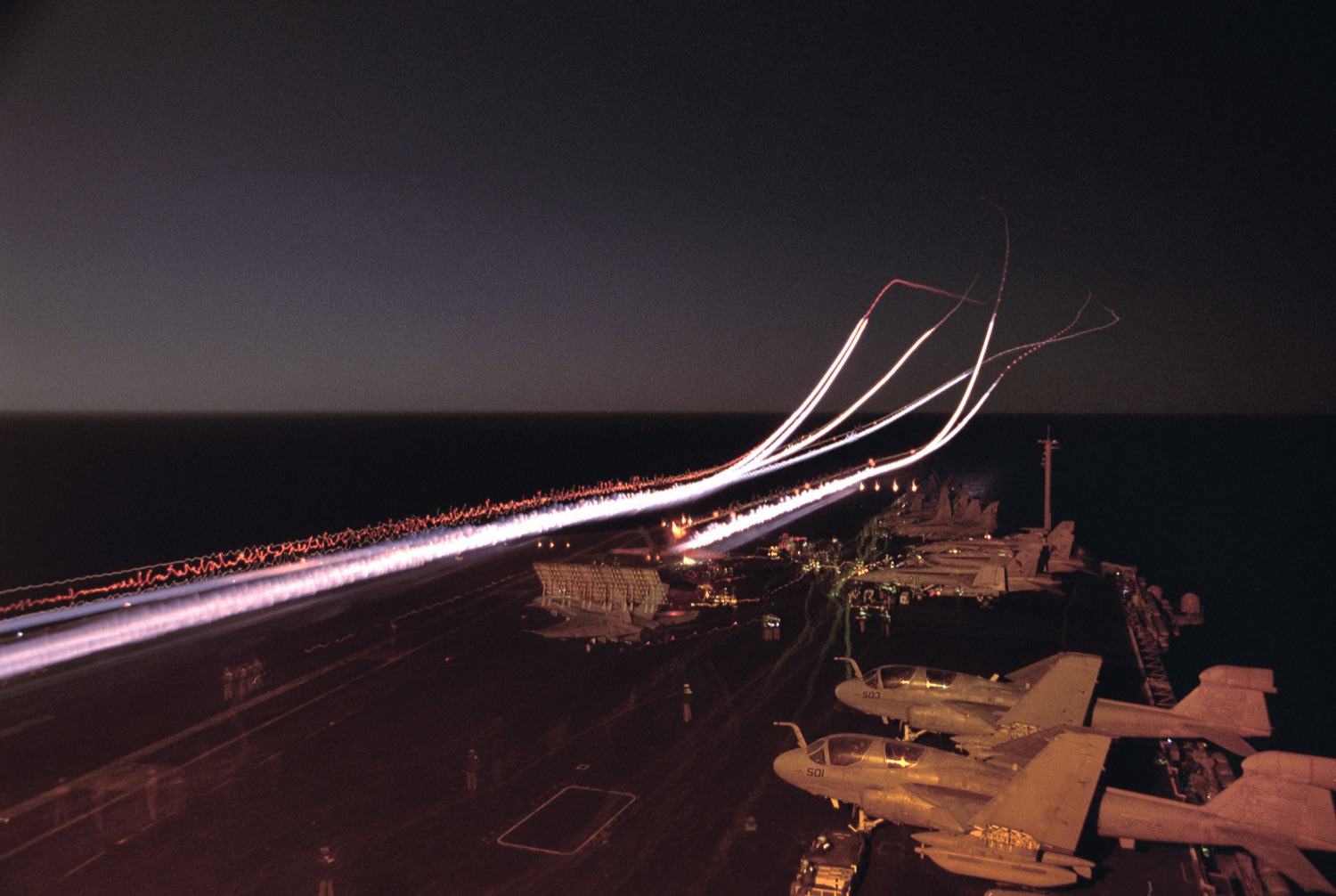
Everyone was coming off the flight deck streaming up north. Two KC-135s were sixty miles south of the Iran-Iraq border and the strike package was headed right for them. They were flying a 40 mile race track pattern at two hundred and eighty knots. I was launched somewhere in the middle of the strike so 10 or 12 guys were already working their rendezvous on the KCs. The night was completely black but I knew there were a bunch of people out there based on what my radar was telling me. I was painting guys everywhere. I put on my night vision goggles and was relieved to find the weather was going to be good for us. The Goggles enabled my to see lights up to a hundred miles away. (The other neat thing is the sky. I can see about four times the normal amount of stars and I see shooting stars every couple of minutes.) Just then they helped me see the rendezvous up ahead. Not pretty. Little white lights, like angry fireflies, everywhere.
There are only a couple of rules when joining on the tankers because it's not that hard to do as a single. It's when twelve of your best friends are trying to get the exact same piece of the sky that things get interesting. Also with the goggles you can't be sure of the range of what you're seeing. That dot of light could be twenty miles away or a half-mile and closing fast. You also can't judge aspect, you can't see where the light is going until you stare at it for a bit. If it doesn't move it's either very far away or on a constant bearing with decreasing range. Consequently you can see there's lots of stuff out there that might hurt you, you just don't know which one's first. Tonight I had a Tomcat cut me off as I was around two miles from the tanker.
I wanted to say something on the radio to let him know I was there but the radios were busy. Dust storms in Saudi Arabia had clobbered the F-15 Eagles' home base. They were supposed to have eight fighters in the box but only two got airborne. There was talk about canceling the strike because of the lack of fighter cover. These thoughts were coming from the Eagle guys themselves. I suspected two main reasons for this. One was ego. If the strike went in even though three quarters of them were still on deck it'd be tantamount to admitting we didn't need them. (We didn't, and still don't.) The second was the storms. They wanted to go back and try to get home right then. Later on was going to be a fuel issue for them. The AWACS (airplane that was controlling the whole effort) talked to Jerimiah (the General with the Tarot cards in Saudi) and Jerimiah said go. God bless him. I was about to find out why.
After the tanker I headed up to the strike rendezvous point. All the strikers and support elements had different altitudes to get their elements together. While this was going on Jerimiah came on the radio. This is a pretty big deal. Typically there's only two things that bring "The Man" to the mike. First one is a mission abort and the weather made that look unlikely. Second reason is to give an execute order, and that's what he did. In the same breath he told Chunks to execute versus the Tallil guns and that my target was gone. The Iraqis had moved it already. Chunks' targeting decisions made a lot more sense to me now but that didn't make it any less frustrating. I was going into southern Iraqi but I wasn't going to do anything. My wingman muttered some kind of expletive on the back up radio. At about the same time (I'm sure) Chunks and his boys were whooping it up on their own back up frequencies.
Regardless of what was about to happen I still had to take my three guys in and out of "The Box" (southern Iraq's nickname) on time. So I focused on that. The various elements of the strike package stopped circling at the rendezvous point and flew northeast into Iraq. I followed Chunks at about eight miles and broke off to the west when the Tigris and Euphrates split. Out to the east the lights of Basra were burning bright. It made it tough to see the little twinkling lights that meant guns were firing. But I knew they were there because every couple of seconds three tracer rounds from the 100mm guns would come up and arc to the west. (It looks a lot like it does on CNN.) The Brits' time on target was just a couple minutes after we passed Basra and I knew they were coming from the west. So I figured the guns must have been shooting at them.
Chunks was going to attack from the north and since I was currently south of their target I could see the whole thing. Tallill airfield was plainly visible on the goggles. (The moon was coming up now and it made things on the ground much more visible.) I was looking over my right shoulder at the twinkling lights on the southeast corner of the airfield (I'd studied his targets too.) and I was thinking, "What would those guys do if they knew?" Chunks and his boys were coming for real this time. It wasn't going to be a flyby where the Gunners get to shoot and then break for dinner. People were going to die down there unless they started running. I could see the two lights of Chunks division (only two guys had their lights on, the two wingman were totally blacked out) and they weren't moving. That meant the jets were pointed at me. That meant they were headed south for the guns.
The first explosion caught me off guard. My goggles totally whited out for a second because of the sudden bright light. The next three, in quick succession, I watched with my unaided eyeballs. Chunks reported to the AWACS that the division had four good hits. The excitement in his voice was pretty high. On the ground, the lights weren't twinkling anymore.
My wingman said something unnecessary and we pressed up to Al Najaf. Right on cue I realized I had to take a piss. The run up to Al Najaf was pretty uneventful. We got within a couple of miles of where the SA-3 used to be and turned around down south. Just before we left we could see Baghdad on the Goggles. On the way out of country I didn't really see anything. Just standard Iraq with widely spaced clusters of dirty yellow lights. More lights in the east as we got towards the rivers. Basra is the biggest city down here and even it's lights aren't that impressive. Tallill airfield looked quiet – licking its wounds.
On the way back to the ship we had to stop back at the KC-135s for some more gas. This rendezvous wasn't as hard because I had three guys with me and Chunks' division was already gone. My wingman was lower on gas then any of us so I let him get behind the tanker and get the gas first. He was having a pretty hard time with it. (We get gas by extending a 4 foot probe from the side of our nose and pushing it into a basket that is hanging from the tanker. Because the tanker is moving so fast the open end of the basket is pointed behind the tanker, at us. When the connection is made gas is pumped through the basket and probe and into our gas tanks. On the smoothest of days it's a little like throwing darts. If the basket is not completely round it will wave around in seemingly random patterns. Turbulence can also affect the basket making it very hard to get in. The difficulty you have getting in is directly proportional to how bad you need to get in.)
His jet was really jerking around, making big plays to get in the basket. He was tense and having three other guys watch him flail around wasn't helping. "Wiggle your toes..." I have no idea why this works but I've found that at times likes these if I wiggle my toes it helps calm me down and I can concentrate. It's an old trick and I think it helped him out as he got in shortly afterwards.
Iraq and the tanker were now behind me. Only a night trap was left between me and a solid nights sleep. Night traps are done differently then day ones. First it's an instrument approach instead of the swirling overhead pattern. Next it's a straight in landing instead of the turning one. This should make it easier, and mechanically it is. But it's not as much fun and the tension level is a bit higher. Tonight wasn't too bad, the moon was up. At three quarters of a mile I could actually see some of the ship. On a typical night approach I can only see a dozen lights in the shape of a rectangle and the ball. The rectangle is where I'm supposed to land, the ball is what I use to get me there. Not a lot of distractions. I really hate night landings, they're bad for my blood pressure.
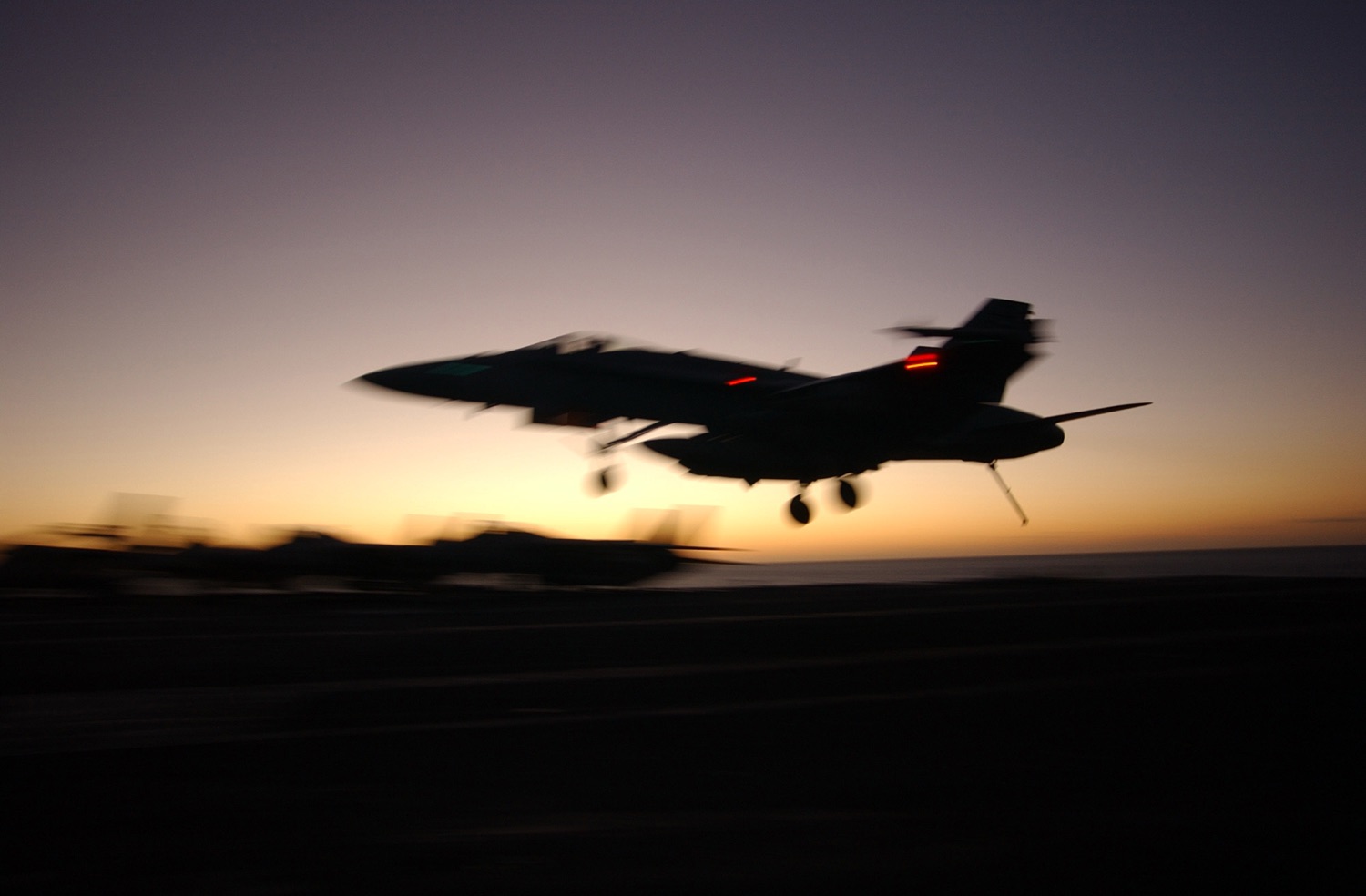
I managed to get the right wire this time, the three. I taxied out and pointed the jet over the side while the ordies dearmed my missiles and gun. Then I got to move my jet up to the bow. All the way up. The nose wheel of the Hornet is a little behind where the pilot sits. So when they taxied me all the way up to the bow to turn around I felt like I was hanging out over the water. I felt this way because I was hanging out over the water. Hate that feeling. Having to do this right after the night trap makes it feel like strange and unusual punishment.
I got off the flight deck quickly and headed back to intelligence center. Chunks and his division were rolling the tapes on their strike. They really schwacked the guns. I was watching one of the FLIR tapes over everyone's shoulders. I could see the berms around the various gun emplacements but not the guns themselves. The pilot wasn't sure he had the right place and the recording had a far number of choice expletives. Then the gun started firing. Little burst of light on the tape right in the middle the berm. Made him easy to spot. The gun kept firing for another thirty seconds or so. Then the bomb hit, right on top of it. (This also looks a lot like CNN.) All the tapes pretty much looked like that.
They wanted to look at my tape too. Just to confirm what they already knew.
The SA-3 was gone.
I went back to the ready room and took off all the gear, put the gun away and plopped down in a chair. It was about eleven and I was exhausted. I didn't realize it until I stopped moving. But the SDO told me I wasn't done yet. The corpsman wanted me to come down and get my Anthrax shot. It just keeps getting funnier.
After the strike debrief and the shot I finally got back to bed about twelve thirty. Tomorrow's (or today's actually) flight schedule looked like more of the same. I had a brief in about seven hours. Giddyup.
Then the cat fired.
More maintenance.